How Grief Affects the Body and Mind Over Time

Losing someone or something deeply important changes a person in ways that are hard to anticipate. Most people expect sadness. Fewer expect the exhaustion that makes getting out of bed feel like a physical task, the strange moments of forgetting the loss ever happened, or the anger that surfaces at completely unrelated situations. Grief is one of the most universal human experiences, yet it consistently catches people off guard. This article explores what grief actually does to the body and mind, why it unfolds differently for different people, and what science says about moving through it.
What Grief Actually Is
Grief is the natural response to loss. That loss does not have to be a death. People grieve the end of relationships, the loss of a job or career identity, a serious diagnosis, a miscarriage, or even the life they expected to have but did not get. The grief response is the mind and body processing a fundamental change in reality.
Psychologists distinguish between grief and bereavement. Bereavement refers specifically to the period following a death. Grief is the broader emotional, cognitive, and physical experience that follows any significant loss. Mourning, a related term, describes the outward expressions of grief, which vary widely across cultures and individuals.
The Diagnostic and Statistical Manual of Mental Disorders (DSM-5) recognizes a condition called Prolonged Grief Disorder, formerly called Complicated Grief, in which intense grief symptoms persist beyond 12 months for adults and 6 months for children. This distinction matters because it separates ordinary grief, which is painful but not a disorder, from grief that has become clinically impairing.
The Physical Side of Loss That Most People Overlook
Grief is not only an emotional event. It is a full-body experience. Research published in JAMA Internal Medicine has found that the risk of a heart attack is significantly elevated in the first 24 hours after a loved one’s death, a phenomenon sometimes called broken heart syndrome or stress cardiomyopathy. The body floods with stress hormones like cortisol and adrenaline, triggering inflammation and putting strain on the cardiovascular system.
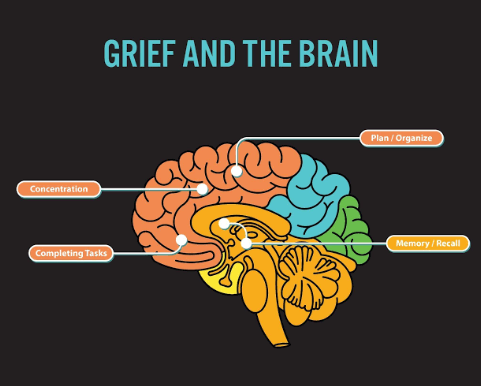
Beyond the heart, grief affects the immune system. A study from Ohio State University found that bereaved individuals showed measurable declines in immune cell functioning, making them more susceptible to illness. Sleep disruption is nearly universal among those grieving. The prefrontal cortex, which handles decision-making and emotional regulation, becomes less efficient under prolonged stress, which is one reason why grieving people often describe feeling foggy, forgetful, or unable to make simple choices.
- Fatigue and low energy that does not improve with rest
- Appetite changes, either loss of appetite or emotional eating
- Sleep disturbances including insomnia or excessive sleeping
- Physical chest tightness or heaviness
- Weakened immune response and increased susceptibility to illness
- Headaches, digestive problems, and muscle aches with no clear physical cause
- Difficulty concentrating, forgetfulness, or mental fog
These symptoms are not signs of weakness. They are signs that the nervous system is under real stress. Dismissing physical grief symptoms as unrelated to the loss is a common mistake that can delay recovery.
Understanding Grief Stages Without Oversimplifying Them
The five stages of grief, denial, anger, bargaining, depression, and acceptance, were introduced by psychiatrist Elisabeth Kubler-Ross in her 1969 book ‘On Death and Dying.’ These stages were originally developed through observations of terminally ill patients facing their own deaths, not necessarily those grieving a loss. They have since been widely applied to bereavement and other forms of loss.
The most important thing to understand about these stages is that they are not a checklist. People do not move through them in order. Some people experience certain stages multiple times. Others skip stages entirely. Many people experience several stages simultaneously. The model is useful as a framework for recognizing that grief has distinct emotional textures, but it should not be used to judge whether someone is grieving correctly.
| Stage | What It Can Look Like | Common Misconception |
| Denial | Feeling numb, going through the motions, disbelief that the loss is real | That the person is being dishonest or avoiding feelings |
| Anger | Frustration, resentment, irritability directed at others or at oneself | That anger means the person has not accepted the loss |
| Bargaining | Replaying ‘what if’ scenarios, feeling guilt, trying to make mental deals | That this is a weak or irrational response |
| Depression | Deep sadness, withdrawing socially, loss of interest in activities | That this is clinical depression and always requires medication |
| Acceptance | Acknowledging the reality of the loss and rebuilding life around it | That acceptance means feeling okay or no longer grieving |
Why Grief Looks Different for Every Person
Two siblings can lose the same parent and grieve in entirely different ways. One might cry openly and talk about the parent constantly. The other might seem calm, focused on logistics, and rarely bring it up. Neither response is wrong. Research into grief consistently shows that individual variation is the norm, not the exception.
Several factors shape how grief unfolds. The nature of the loss matters enormously. A death that was sudden and traumatic tends to produce a different grief experience than one that followed a long illness. The relationship with the person lost also matters. Ambivalent relationships, those marked by conflict or complicated feelings, can produce grief that is harder to process because it carries unresolved emotions.
Social support is one of the strongest predictors of healthy grief outcomes. People who have others they can speak honestly with tend to move through grief more effectively than those who feel they must grieve alone or in silence. Cultural expectations around grief also play a role. Some communities create structured rituals and communal mourning periods. Others expect people to return to normal functioning quickly, which can leave individuals feeling that their grief is a burden or a failure.
Disenfranchised Grief
Disenfranchised grief refers to losses that are not openly acknowledged or socially supported. The death of a pet, the end of a relationship that others did not take seriously, a miscarriage, the loss of a friendship, or grief over a public figure are all examples. When grief is disenfranchised, the person experiencing it often feels they do not have the right to mourn, which can intensify and prolong the grieving process.
When Grief Becomes Something That Needs Professional Support
Most grief, even severe grief, does not require clinical intervention. Time, social connection, and the natural adaptability of the human mind carry most people through. But for some, grief gets stuck. Symptoms intensify rather than gradually easing. The person begins to lose functioning at work, in relationships, or in basic self-care. Thoughts of self-harm or suicide may emerge.
According to the American Psychological Association, approximately 7 to 10 percent of bereaved adults will develop Prolonged Grief Disorder. This is not a reflection of how much someone loved the person they lost. It is a clinical condition influenced by many factors, including prior mental health history, the circumstances of the loss, and the availability of support. If you recognize that your grief has not shifted in a long time, that you feel permanently stuck, or that daily life has become unmanageable, grief counseling may help you begin to process what has been too difficult to work through alone.
Therapists who specialize in grief use several evidence-based approaches. Cognitive Behavioral Therapy adapted for grief helps identify thought patterns that maintain distress. Complicated Grief Treatment, a specialized protocol developed by researchers at Columbia University, has shown strong outcomes in clinical trials. Acceptance and Commitment Therapy helps people build a relationship with their grief rather than fighting against it.
Practical Ways to Support Yourself Through Grief
There is no shortcut through grief, and attempts to suppress or rush it tend to backfire. What does seem to help, according to both research and clinical experience, is a combination of allowing the grief to exist without judgment and maintaining enough structure and connection to keep functioning.
- Allow grief to be present without setting a timeline for when it should end
- Maintain basic physical routines around sleep, eating, and movement, even imperfectly
- Talk to people you trust, not because it fixes anything, but because isolation tends to intensify grief
- Create small rituals of remembrance that feel meaningful rather than performing grief in ways that feel hollow
- Limit major decisions during acute grief when possible, as judgment is genuinely impaired
- Watch for signs that grief is becoming prolonged or is interfering seriously with daily functioning
- Consider a support group, which connects you with people who understand loss without requiring you to explain yourself constantly
Something worth saying clearly: taking care of yourself while grieving is not a betrayal of the person or thing you lost. Grief is not a measure of love. Surviving grief and eventually finding ways to live alongside it is not forgetting. Many people carry grief for the rest of their lives and still build meaningful, connected existences. The goal is not to stop grieving but to integrate the loss into a life that can still hold good things.
Grief is not a problem to solve. It is a process to move through, with the pace and shape determined by the individual, not by social expectations or timelines. Understanding what grief does to the body and mind, recognizing the many forms it can take, and knowing when additional support makes sense are all part of honoring the experience honestly rather than rushing past it.