How to Accurately Read a Pool pH Test Kit Between Color Levels

It is important to keep your swimming pool water balanced so that you can enjoy a clean, comfortable, and safe pool. pH is one of the most critical measures to track since it influences the sanitizers effectiveness, the comfort of the water, and pool equipment performance.
A pool pH test kit allows you to see the acidity or alkalinity of your water, but it is not always easy to identify the number when the color is between two numbers on the testing chart. Knowing how to read the color changes accurately can facilitate the correct chemical changes and balanced water.
Why Pool pH Levels Matter
The pH of the water in your pool tells you if your water is too acidic, too alkaline, or just right. Keeping the range in place will avoid common pool problems.
If the pH is too low, you could experience:
- It will corrode metal parts
- Damage to pool surfaces
- This causes eye or skin irritation
- Reduced swimmer comfort
If the pH is too high, it can lead to:
- Cloudy water
- Scale buildup
- Reduced sanitizer effectiveness
- Mineral deposits
Frequent testing using a pool pH test kit allows you to detect changes before they cause bigger problems in the water quality.
How a Pool pH Test Kit Works
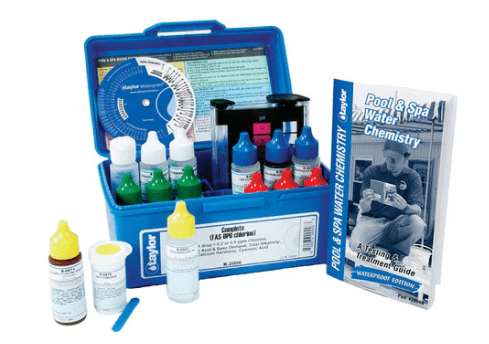
A standard pool pH test kit is based on a chemical reaction that will indicate the acidity of the water in your pool by changing color. A sample of the water is added, and a test solution is added to it, and then the color is compared with a chart to see what the pH is.
Most kits have a set of colors that indicate the pH range. But the result is not always as perfect as one color. The test color may sometimes be between two colors, making it difficult to see which one has the correct reading.
Reading Between Two Color Levels
If your test result is between two colors, don’t assume that you are in the one that’s closest. Rather, employ a careful comparison method.
Follow these steps:
Compare in Natural Lighting
Colors can be impacted by light. The test color may appear differently at different times because of bright indoor lights or shadows.
To get the most accurate reading:
- Whenever possible, use natural light
- Do not let the sample be in direct sunlight
- Compare colors with the eye at the same height as the object
This makes it easier to identify the closest match.
Look at the Overall Color Tone
If the outcome is in between, concentrate on the tone as a whole and not on minute details.
Ask yourself:
Is the color nearer to the lower reading?
Is it nearer to the top reading or the bottom reading?
Does it seem to be slightly more acidic or alkaline?
For instance, if the color falls in the range of pH 7.4 to 7.6, you can take an average of 7.5 and adjust accordingly to suit your desired range.
Use Pool pH Test Strips for Quick Confirmation
Pool pH test strips are also popular tools for pool owners to keep track of water chemistry. Test strips quickly change color when they come in contact with pool water.
They can assist you to do a quick check up:
- pH levels
- Sanitizer levels
- Alkalinity
- Other chemical factors
Test strips are simple to use, but the results can only be as accurate as the way they are handled and as soon as they are read within the recommended time.
To improve accuracy:
- Do not allow strips to become wet prior to use
- Avoid touching the testing area
- Follow the timing directions
- Replace expired strips
Wrong use of testing methods can result in false readings. Examples of common mistakes are the following:
Testing Immediately After Adding Chemicals
Chemicals added to the pool must be allowed to mix throughout the pool. If the test is done too early, the results may not accurately represent the water condition.
Using Expired Testing Products
Color changes from old reagents and/or out-of-date pool pH test strips may be unreliable.
Taking Samples near Return Jets
Chemistry of water near circulation points may not be representative of overall pool chemistry. Collect samples from deeper water areas that are not directly affected by the chemicals.
Comparing Colors Too Late
Most tests have a time limit for reading. Color will continue to change if left too long, and this will impact accuracy.
How Often Should You Test Pool pH?
Standard tests are used to regulate water stability. Testing is based on use of the pool, chemical changes and weather.
You may need to test more frequently:
- Following heavy swimmers
- After rainfall
- During hot weather
- After adding chemicals
- In the event that water appearance changes
Once you test regularly, you will be in a position to spot issues early and make fewer big mistakes.
Once pH has been measured, pH adjustments can be made.
After a correct reading, you can then check to see if adjustments are necessary.
If pH is low:
May need a pH increaser
If pH is high:
May require a pH reducer
Always make gradual adjustments and allow time for chemicals to circulate before testing again.
It is usually safer to make small corrections than big changes at once.
Why Accurate pH Testing Improves Pool Maintenance
Your whole pool care regimen relies on correct pH balance. At the optimum pH:
- Healthcare workers will be more effective at using sanitizers.
- Water is more comfortable to wear
- Pool surfaces are better covered up.
- Equipment lasts longer
- Chemicals are easier to manage.
A good pH test kit and knowing how to interpret the color changes will help you to better inform yourself about your pool maintenance.
Final thoughts
The reading of a test result between color levels may seem difficult, but careful reading and correct testing methods can help increase the accuracy of the result. To achieve better water balance, you can use a quality pool pH test kit, test in good light, and confirm the results with pool pH test strips.
The accurate monitoring of pH is a crucial aspect of pool maintenance, as it contributes to the cleanliness of the water, effective sanitizer action, and a more enjoyable swimming experience.